
 Slovenčina
 Čeština
You want to buy a CO2 laser and you have a very limited budget. Is it better to buy a new Chinese CO2 laser with a...

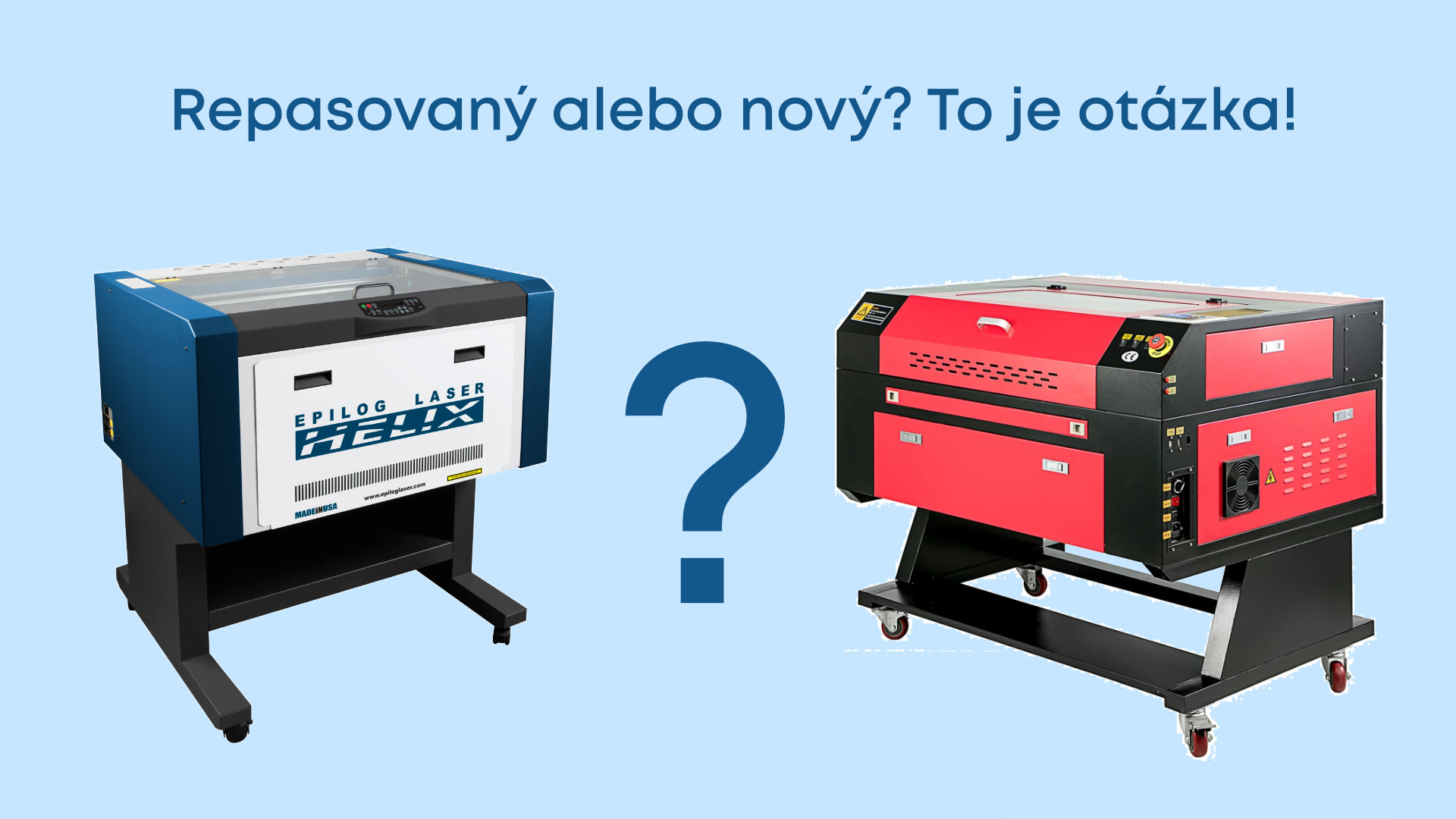
You want to buy a CO2 laser and you have a very limited budget. Is it better to buy a new Chinese CO2 laser with a...
Laser engraving business is very popular nowadays because it is highly profitable, you can start it even while...
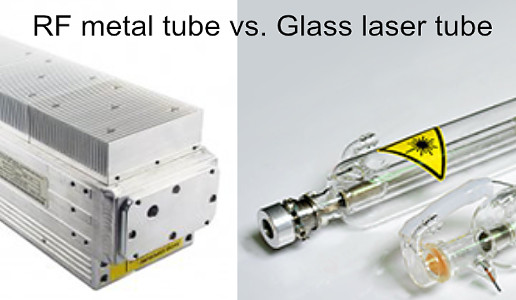
CO2 lasers are sold on the market with two types of laser sources – glass and RF metal laser tubes. What is the...
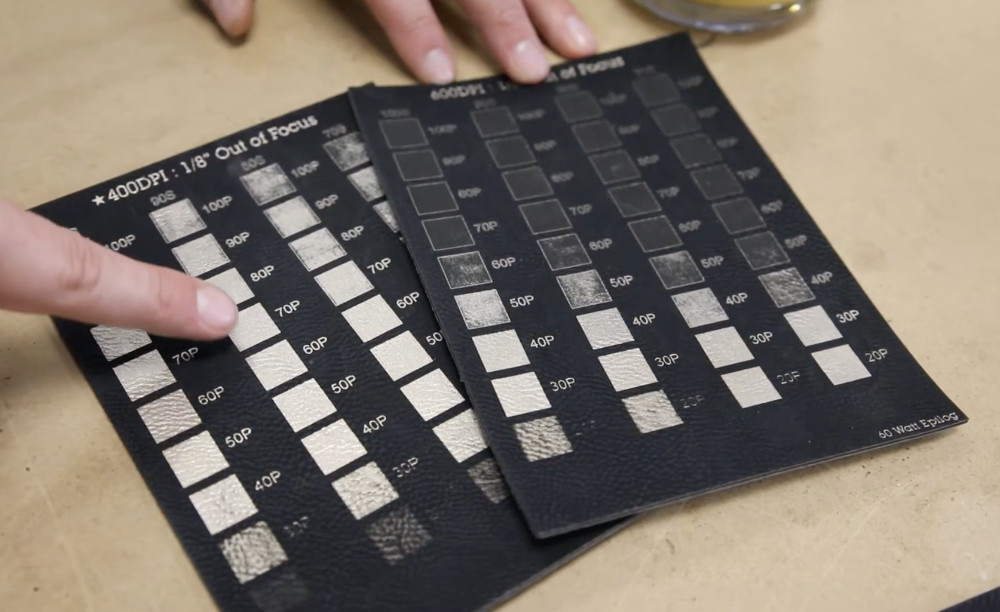
A short video shows how to find suitable parameters for engraving Leatherette sheets.
Do you have an idea of what you want to produce, but don't know which type of laser is best for your job? Here's a...
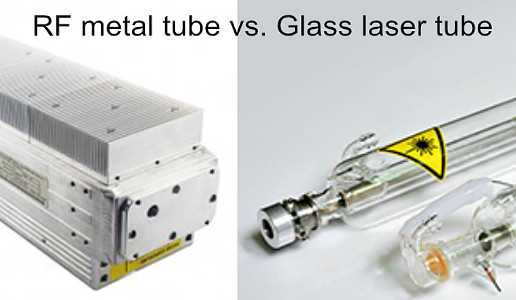
CO2 lasers are lasers that use a CO2 laser tube as a laser beam source. CO2 tubes can be glass or metal. The principle of laser beam generation is the same: a mixture of gases is pressurized in a narrow chamber, consisting of a mix of CO2, Helium, Nitrogen and possibly other gases. (Each manufacturer strictly guards the exact composition). Since the main component is CO2, these sources are called CO2 laser sources, or tubes, since they have a tubular shape.
There are two electrodes in the chamber with compressed gas: an anode at one end and a cathode at the other. When we apply an electric voltage to the electrodes, a flow of photons is excited and light radiation is created. This is amplified in the gaseous environment and at the end of the chamber the laser beam comes out through a semi-transparent mirror.
1, Glass laser tubes.
Construction:
These are glass flasks with two separate chambers. The inner chamber contains a mixture of gases and electrodes are welded into it at both ends. The second chamber – the outer one, in which a cooling medium circulates, i.e. distilled water mixed with antifreeze. When a laser beam is generated, a lot of heat is released, so the chamber with the gas must be cooled. An external cooling unit is used for this cooling, which is outside next to the laser engraver, or is built directly into its housing.
Power supply:
the glass tube is powered by a high voltage of 10 to 20,000 volts.
Laser beam quality:
the laser beam does not have a precise circular shape, therefore the quality of engraving small details is worse. In addition, the glass tube has a 5x larger laser beam diameter than a metal tube, so it cannot engrave such small details. See the comparative tests in the article below.
Lifespan:
The average lifespan of a glass tube is approximately 1000 to 2000 hours, i.e. approximately 1 to 2 years.
Performance stability:
The power can fluctuate during engraving, which negatively affects the quality of the engraved surface. However, below 20% power, the power cannot be controlled at all.
Price:
They are relatively cheap, e.g. a 100W tube costs 800 to 1000 Euros (20,000 to 25,000 CZK excluding VAT)
The price calculated for the lifespan is 0.5 to 1.00 Euros (12 to 25 CZK + VAT) per 1 hour of work.
2, RF metal laser tubes.
Construction:
They are metal - aluminum square bodies that have separate separate spaces for placing electronics and a separate part is a narrow approximately 2 mm wide slit where the pressurized gas is. This slit has a ceramic insert in more powerful tubes. The walls of the slit have a reflective layer applied, from which the light beam is reflected and thus amplified. The photon flow here is excited by a radio frequency signal, which is why these tubes are labeled RF. When a laser beam is created, heat is also released, but much less than in a glass tube. Therefore, the body is made of aluminum and also has fins for better cooling. These tubes are usually air-cooled up to 60W but higher. Fans are placed above the tube to ensure cooling.
Power supply:
The tubes are powered by a low voltage of 30V or 48W.
Laser beam quality:
The laser beam has an almost ideal circular shape, so the quality of engraving small details is also very good and they can engrave at a resolution of up to 1200 dpi and engrave readable text smaller than 1 mm. Metal tubes have a 5x smaller laser beam diameter than glass ones, so the energy is concentrated into a smaller point. Therefore, the tube has higher efficiency. Thanks to this, a metal tube with a power of, for example, 40W cuts the same thick material as a 70W glass tube.
Service life:
The average service life of a metal tube is about 10,000 to 20,000 hours, or about 7 to 10 years. The service life depends on how high the average power you work and how many hours a day you work.
Stability of power:
The power is very stable and therefore the engraved surfaces are of very high quality. The power can be controlled very precisely in steps of 1% from 0 to 100%. This allows even materials that are very sensitive to heat to be engraved evenly.
Price:
Since these are much more sophisticated and technically demanding devices, their price is much higher than glass tubes, which are very primitive in design compared to metal ones. However, after the gases are used up, metal tubes can be reconditioned several times. During reconditioning, they are filled with new gas and the electronics are reconditioned.
A reconditioned tube has a service life of at least 80% of the service life of a new tube.
The price of a 30W RF metal tube is around 3000 to 4000 Euros (75,000 to 100,000 CZK), reconditioning costs about 50,000 to 75,000 CZK).
What are lasers with glass and RF metal tubes suitable for?
Our recommendations are:
Lasers with glass tubes:
are mainly suitable for cutting larger details than 5 mm and for occasional engraving where the highest quality is not required. They are commonly used for cutting textiles, cutting wood, plywood, acrylic, etc. For engraving mainly wood.
They are not suitable for high-quality engraving of fine details, such as the description of advertising items and for high-quality stamp plates. They are also not suitable for engraving glass, because the thicker laser beam creates larger cracks in the glass. They are also not suitable for high-quality engraving of anodized aluminum and heat-sensitive materials, where engraving is performed at low power.
Lasers with RF metal tubes:
are suitable wherever high engraving quality is required – engraving of promotional items, high-quality stamp plates, engraving of glass, anodized aluminum, for engraving photos, engraving and cutting of acrylic in the highest quality, engraving and cutting of paper, etc. They can engrave and cut even extra small details.
Comparative tests of engraving of glass and RF metal tubes:
How to choose right type of laser machine?
How to start laser engraving business?
Why is buying a refurbished metal tube laser a smart choice?
Leave a comment